Understanding the Travel Impact
Updated February 24, 2026
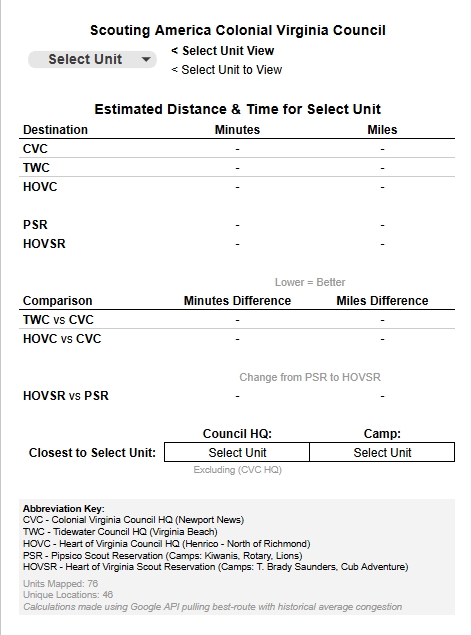
The map and tables below show where CVC units are located and how far the average family travels to reach key Scouting destinations. This provides a clear, visual overview of how different structural options—independence, consolidation with TWC, or a merger with HOVC—impact access and program participation across Hampton Roads.
View our latest in-depth post all about this travel study here — and see how it fits into a much larger ‘appendage or core’ decision for CVC here.
In addition to council-wide averages, we also compared each unit individually to determine which merger option results in shorter, real-world travel for families. Out of 94 units:
- 81 units are closer to both Tidewater’s HQ and Pipsico Scout Reservation
- 8 units are closer to Pipsico but closer to the Heart of Virginia HQ
- 4 units are closer to Tidewater’s HQ but closer to the Heart of Virginia camp (HOVSR) by an average of only 6 minutes
- 1 unit in Gloucester is technically closer to both Heart of Virginia destinations — but only by 5 minutes for camp and 1 minute for the HQ, not enough to materially change the overall regional trend
Because minutes and miles don’t always align, each unit was compared using actual Google routing times — the best reflection of what families experience on the road.
Across all 94 units analyzed, none are meaningfully closer to both the HOVC headquarters and HOVSR. Under a HOVC–CVC merger, virtually every unit sees increased travel in at least one direction compared to a TWC–CVC consolidation, and for many units that increase is substantial.
This data includes 94 CVC units across 55 meeting locations. CVC rechartered 99 units at the end of 2025. Those 5 units we are missing locations for are Council chartered units and most likely ScoutReach programs at local elementary and middle schools in the peninsula, which would also be closer to both TWC and PSR. Many chartered organizations host more than one unit, so the averages are weighted to reflect how many units meet at each site. Unit data comes from the BeAScout service, and all drive times were estimated using Google’s routing API, which incorporates best-route logic and typical traffic conditions. Together, this provides a grounded, realistic snapshot of travel impact across the council.
To see how these scenarios affect your specific unit, use our interactive unit-level tool:
👉 View Your Unit’s Travel Impact Data: Here
If your unit is missing or your meeting address has changed, please let us know so we can update the study.
CVC Unit & Key Scouting Locations Map
CVC Average Unit Impact Study
👉 View Your Unit’s Travel Impact Data: Here in Google Sheets
The travel data answers one critical question: what will families actually experience on the ground?
As the unit-level analysis shows, nearly every CVC unit travels farther — often significantly farther — under an HOVC-centered structure than under a Tidewater-aligned one, both for council headquarters and for camp access Travel – Hampton Roads Scouting….
But travel is only one dimension of the decision.
When you zoom out beyond miles and minutes and examine population patterns, metropolitan regions, media markets, and governance structure, the same conclusion emerges at a broader scale: where a council is centered determines who is core — and who becomes peripheral.
That larger question is the focus of our post: