Dear Scouting Friend,
As conversations continue about potential changes to Colonial Virginia Council (CVC), it’s essential that families and volunteers understand how each option would affect their access to Scouting. CVC leaders are currently evaluating three broad pathways: remaining independent, merging with Heart of Virginia Council (HOVC), or consolidating with Tidewater Council (TWC). Each option carries different implications for travel, regional alignment, and program accessibility.
To support that, the Hampton Roads Scouting Alliance has completed a new CVC Driving Impact Study, built using Google routing data and real meeting locations for 94 CVC units across 55 unique sites.
You can now explore the full set of tools—including the interactive map, the CVC average travel table, and the unit-specific impact calculator—all in one place at:
👉 https://hrscouting.org/tavel-study/
If your unit is missing, you can share meeting location details at:
👉 https://hrscouting.org/contact
CVC Unit Locations & Key Scouting Destinations
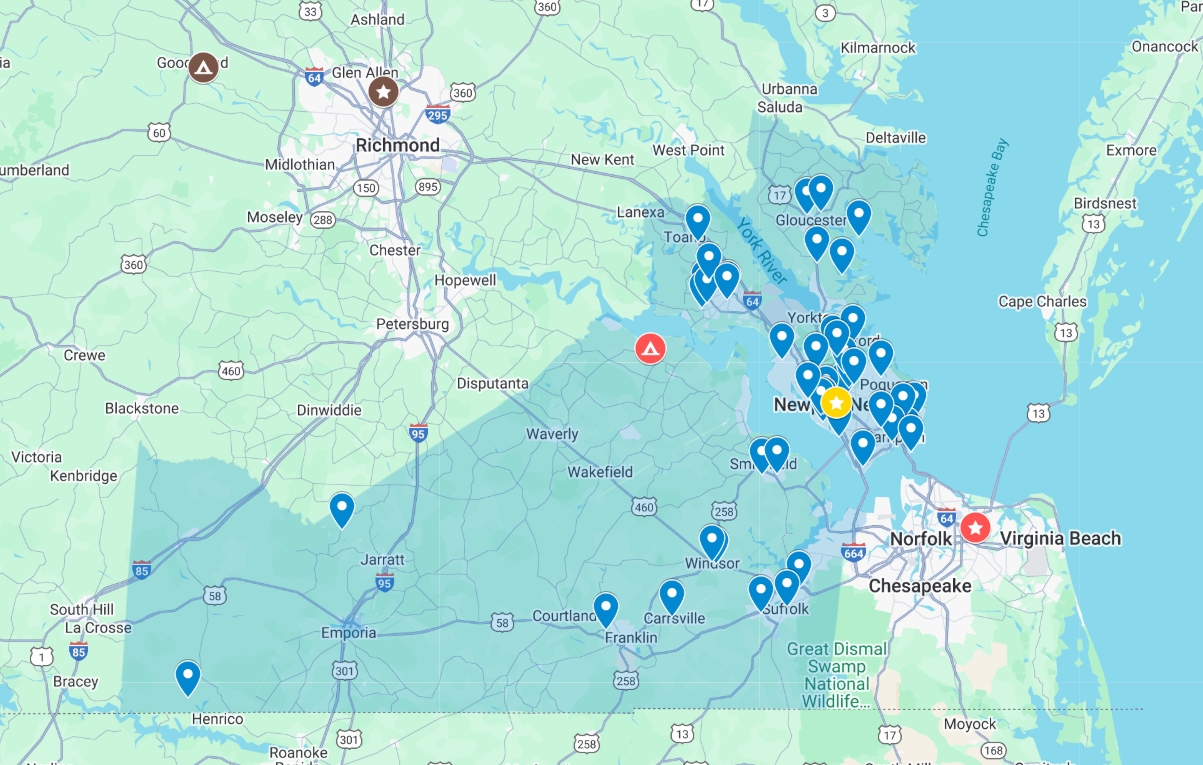
1. What the Data Shows: Average One-Way Travel for a CVC Unit
Updated 2/24/2026
Council Service Centers (Each Way)
| Destination | Avg Mins | Avg Miles | Est. Travel Cost¹ | Comments |
|---|---|---|---|---|
| CVC HQ (Newport News) | 29 | 21.0 | $15 | Baseline |
| TWC HQ (Virginia Beach) | 46 | 37.0 | $27 | Relatively modest increase |
| HOVC HQ (Henrico) | 79 | 77.9 | $56 | Over 3.5x farther distance vs CVC |
Key:
CVC = Colonial Virginia Council Service Center (Newport News)
TWC = Tidewater Council Service Center (Virginia Beach)
HOVC = Heart of Virginia Service Center (Henrico – North of Richmond)
¹ Approximate vehicle operation cost using the 2026 Federal Business Reimbursement Rate ($/mile) of $0.725 reflecting fuel, maintenance, wear, and depreciation.
Camps / Program Centers (Each Way)
| Camp | Avg Mins | Avg Miles | Est. Travel Cost¹ | Comments |
|---|---|---|---|---|
| PSR (Pipsico) | 69 | 44.2 | $32 | Baseline (Minutes incl. ferry transits) |
| HOVSR (T. Brady Saunders / Cub Adventure Camp) | 103 | 100.6 | $73 | Over 2x farther distance each way vs PSR |
Key:
PSR = Pipsico Scout Reservation – Camps: Kiwanis, Rotary, Lions (Spring Grove, VA)
HOVSR = Heart of Virgina Scout Reservation – Camps: T. Brady Saunders, Cub Adventure (Maidens VA)
¹ Approximate vehicle operation cost using the 2026 Federal Business Reimbursement Rate ($/mile) of $0.725 reflecting fuel, maintenance, wear, and depreciation.
Camp access is one of the most important factors in delivering a strong Scouting program—camp is where advancement happens, outdoor skills are learned, council events take place, OA activities are held, and major trainings like NYLT and Wood Badge are delivered. When camps are farther away, participation drops, costs rise, and these opportunities become much harder to sustain.
Key Comparisons (Each Way)
| Comparison | Minutes Difference | Miles Difference | Cost Difference¹ | Implications |
|---|---|---|---|---|
| TWC vs CVC | +17 | +16.0 | +$12 | Modest increase; generally manageable. |
| HOVC vs CVC | +50 | +56.9 | +$41 | Adds over 1.5 hrs & 110 mi per round trip. |
| HOVSR vs PSR | +34 | +56.4 | +$41 | Adds over 1 hr & 110 mi per round trip. |
In addition to council-wide averages, we also compared each unit individually to determine which merger option results in shorter, real-world travel for families. Out of 94 units:
- 81 units are closer to both Tidewater’s HQ and Pipsico Scout Reservation
- 8 units are closer to Pipsico but closer to the Heart of Virginia HQ
- 4 units are closer to Tidewater’s HQ but closer to the Heart of Virginia camp (HOVSR) by an average of only 6 minutes
- 1 unit in Gloucester is technically closer to both Heart of Virginia destinations — but only by 5 minutes for camp and 1 minute for the HQ, not enough to materially change the overall regional trend
Because minutes and miles don’t always align, each unit was compared using actual Google routing times — the best reflection of what families experience on the road.
Across all 94 units analyzed, none are meaningfully closer to both the HOVC headquarters and HOVSR. Under a HOVC–CVC merger, virtually every unit sees increased travel in at least one direction compared to a TWC–CVC consolidation, and for many units that increase is substantial.
2. Why Driving Distance Matters
Longer trips can create practical barriers:
- Higher fuel and travel costs
- Less available time for program and family
- Reduced volunteer participation
- Lower youth accessibility for weeknight or multi-day events
- Weaker retention and recruitment
Ease of access directly shapes program strength.
3. What Virginia’s Transportation Projects Tell Us
Virginia invests based on how communities actually live and commute—not on administrative lines. Two major statewide projects highlight the true regional alignment behind the merger discussion.
A. I-64 “Gap” Widening (Williamsburg → Richmond)
Relevant to a CVC–HOVC merger
This project eases westbound travel but does not address the core issue:
- HOVC HQ remains over 55 miles farther and 2.7x longer drive time each way
- The Richmond area remains significantly farther for most CVC families
- HOVSR (Camps T. Brady & Cub Adventure) remains 100 miles away, over 2x the distance to Pipsico, an additional 1 hour+ of driving for a round trip
CVC’s communities are simply not oriented toward Richmond.
B. HRBT Expansion (Hampton Roads Bridge–Tunnel)
Relevant to a CVC–TWC consolidation
The HRBT expansion—the largest transportation investment in the history of Virginia—strengthens:
- Peninsula ↔ Southside mobility
- Daily regional travel
- Access across the communities that CVC and TWC already serve
CVC and TWC both serve communities within the broader Hampton Roads region, where families naturally live, commute, and participate across city and county lines. These communities already share the same media market, news outlets, transportation systems, and economic ties.
Hampton Roads is recognized as one connected region. Richmond, by contrast, is a separate region with different commuting patterns, media markets, and community identity. This reflects what families experience every day: CVC families are part of Hampton Roads—not Richmond.
Improved connectivity across Hampton Roads directly supports council meetings, district activities, OA events, leader training, and volunteer collaboration in a unified CVC–TWC structure.
In short: The HRBT expansion strengthens the region where a combined CVC–TWC council would actually operate.
4. What This Means for Scouting
If CVC Merges With HOVC
- HQ travel increases by 55 minutes each way on average
- Camp travel miles and estimated costs more than double and time increases over 30 minutes each way on average
- Council center shifts to northern Richmond
- Increased burden on families
If CVC Consolidates With TWC
- HQ travel increases by only 17 minutes each way on average
- Camp travel remains familiar (PSR)
- Council remains rooted in Hampton Roads
- Regional mobility improvements enhance program access
The study makes one point clear: CVC families are part of Hampton Roads—not Richmond.
5. Explore the Data for Your Unit
All tools—including:
- The interactive travel map
- The CVC average travel analysis
- The unit-specific impact calculator
Are available at:👉 https://hrscouting.org/tavel-study/
If your unit’s location is missing or outdated, please contact us so we can update the analysis.
6. Our Ongoing Position
- CVC independence remains a strong and viable option
- If consolidation becomes necessary, TWC is the better geographic and cultural fit
- Decisions should prioritize accessibility, transparency, and what best supports youth and volunteers
We encourage everyone to consider how each option affects the young people they serve—and ensure those realities are reflected in their feedback to CVC leadership.
Yours in Scouting,
Concerned People of Colonial Virginia Council and Tidewater Council
Hampton Roads Scouting Alliance – Protect Hampton Roads Scouting