
Population, travel, media, and communication boundaries all agree: CVC aligns with Tidewater — not Richmond.
To: Colonial Virginia Council Members, Leaders, Families, and Community Supporters
From: Hampton Roads Scouting Alliance
Subject: Appendage — or Core. What is your choice?
Dear Colonial Virginia Council Scouters,
After attending University of Scouting this past weekend, it’s time to pause and ask a simple but decisive question:
Are CVC communities being positioned as the CORE of a future council — or as an APPENDAGE to someone else’s?
When you examine the geography, population data, travel realities, independent regional analysis, and our Full Merger Review⁵, the direction currently being advanced does not follow the evidence.
And that should alarm every CVC member.
Key Takeaway
Independent population data¹, federally defined Metropolitan Statistical Areas (MSAs)², Nielsen Designated Market Areas (DMAs)⁹, unit-level travel analysis⁶, independent regional studies³ ⁴, and our comprehensive Full Merger Review⁵ all point to the same conclusion:
A consolidation with Tidewater Council (TWC) keeps CVC communities in the core of council life.
An acquisition by Heart of Virginia Council (HOVC) makes CVC an appendage to a Richmond-centered structure.
Despite this, the CVC Executive Board has continued to advance and effectively rubber-stamp the HOVC option, while the Tidewater option has not received full, equal, documented consideration. CVC members should be vocal at town halls, talk to their Council Voting Members (including CORs) now, and be prepared to vote NO on an HOVC–CVC merger.
Map 1: Council Territories, Key Locations, MSA Borders, Population Density Groups
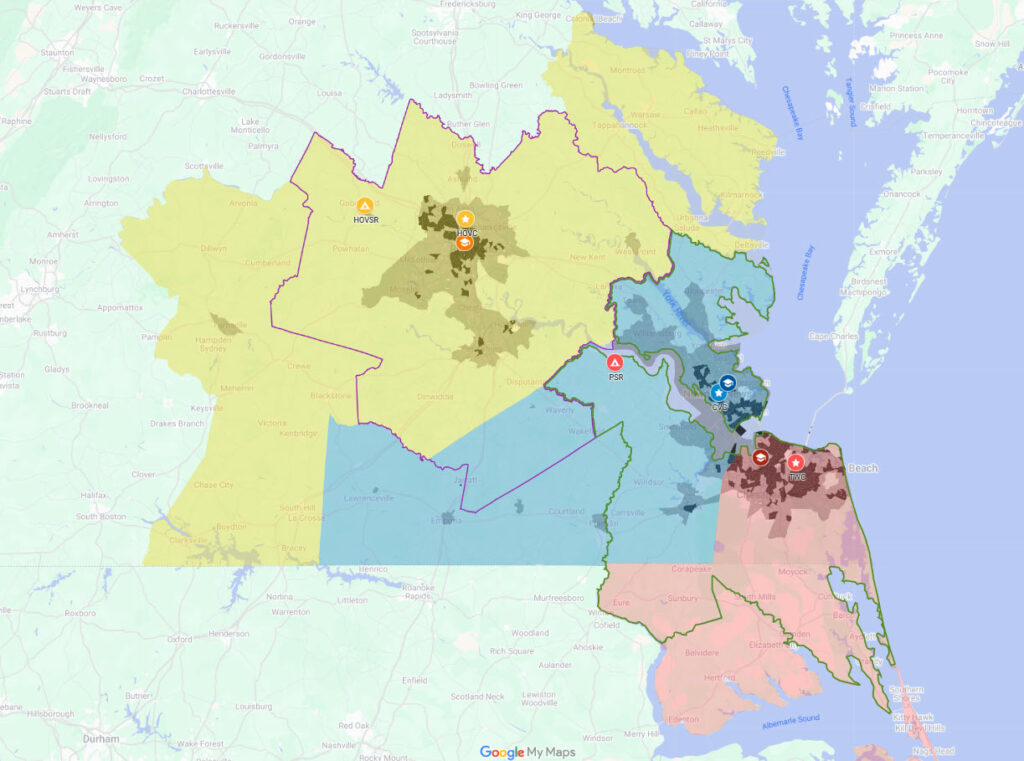
MAP LEGEND – View the full map HERE
Council Territories
🟨 Yellow — Heart of Virginia Council (HOVC) territory
🟦 Blue — Colonial Virginia Council (CVC) territory
🟥 Red — Tidewater Council (TWC) territory
Key Council Locations (Icons are color-matched to each council)
⭐ Council Headquarters
⛺ Primary Council Camp / Reservation
🎓 2026 University of Scouting Location
Metropolitan Statistical Areas (MSAs)
🟪 Purple Outline — Richmond, VA Metropolitan Statistical Area
🟩 Green Outline — Hampton Roads Metropolitan Statistical Area
Population Density Groups (ACS 2019–2023)
Dark shading — Urban (3,000–21,000 people per sq. mile)
Medium shading — Suburban (300–2,999 people per sq. mile)
Light/No shading — Rural (0–299 people per sq. mile)
Metropolitan Areas Are Not Bureaucratic Lines — They Reflect Real Communities
The map above uses the latest American Community Survey (ACS) population estimates¹ and federally defined MSAs².
MSAs exist because they describe how communities actually function:
- where families live and work
- how people commute
- where institutions naturally locate
- how regional economies and media markets align
This matters in Scouting because program access follows population and geography, not wishful thinking.
The data shows, clearly and consistently:
- HOVC aligns squarely with the Richmond MSA¹²
- The overwhelming majority of CVC communities align with the Hampton Roads MSA¹²
- TWC aligns with that same Hampton Roads MSA¹²
This is not preference. It is structure.
Map 2: Detailed Population Heatmap— Where People Actually Live
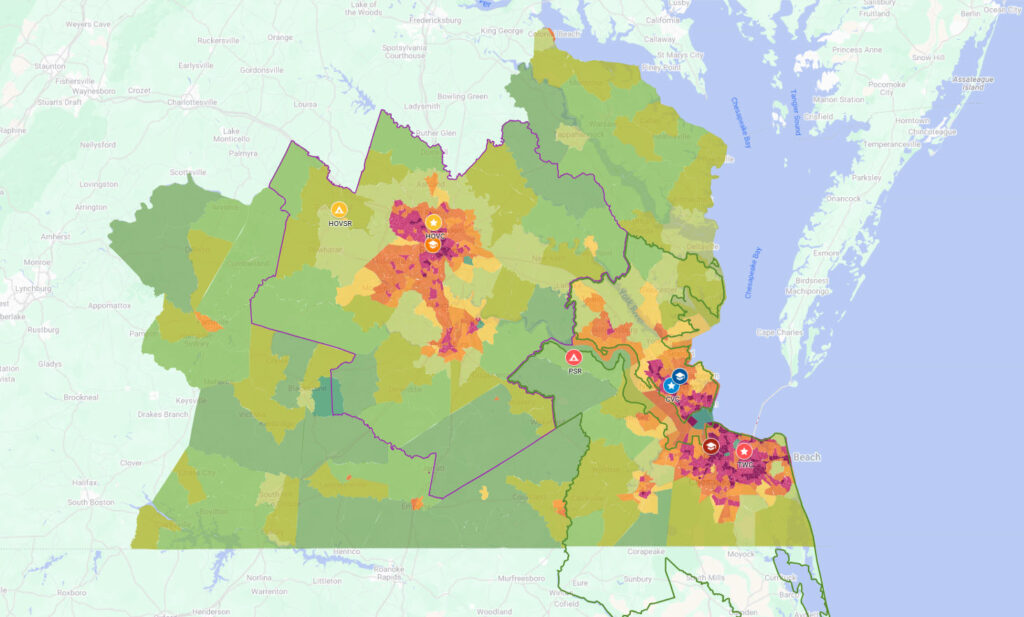
This second map is a heatmap that uses population-density in 11 ranges from 1 (Green) to >5000 (Dark Red) at census-tract resolution, revealing how sharply population concentrates in practice. You can view this as a layer in the same map as above (you may have to unhide it). Also included are the MSA boundaries and key council locations.
What it shows unmistakably:
- The Hampton Roads core is denser, more continuous, and more population-rich than anything between CVC and Richmond
- The corridor between CVC communities and Richmond is comparatively lower density and fragmented
- The difference is not just distance — it is where people are, and are not
Together, these maps show not only where lines are drawn, but where council gravity naturally forms.
Other Real-World Boundaries Tell the Same Story
Population density and MSAs are not the only systems that reflect how regions actually function.
When we overlay media markets (DMAs)⁹ and telephone area codes¹⁰ — two boundaries shaped by where people live, work, communicate, and consume local information — the same alignment appears again.
CVC communities consistently align with Tidewater Council, not Heart of Virginia Council.
Map 3: Media Markets (DMAs) and Council Territories
(See map below — local television, radio, and digital media markets)
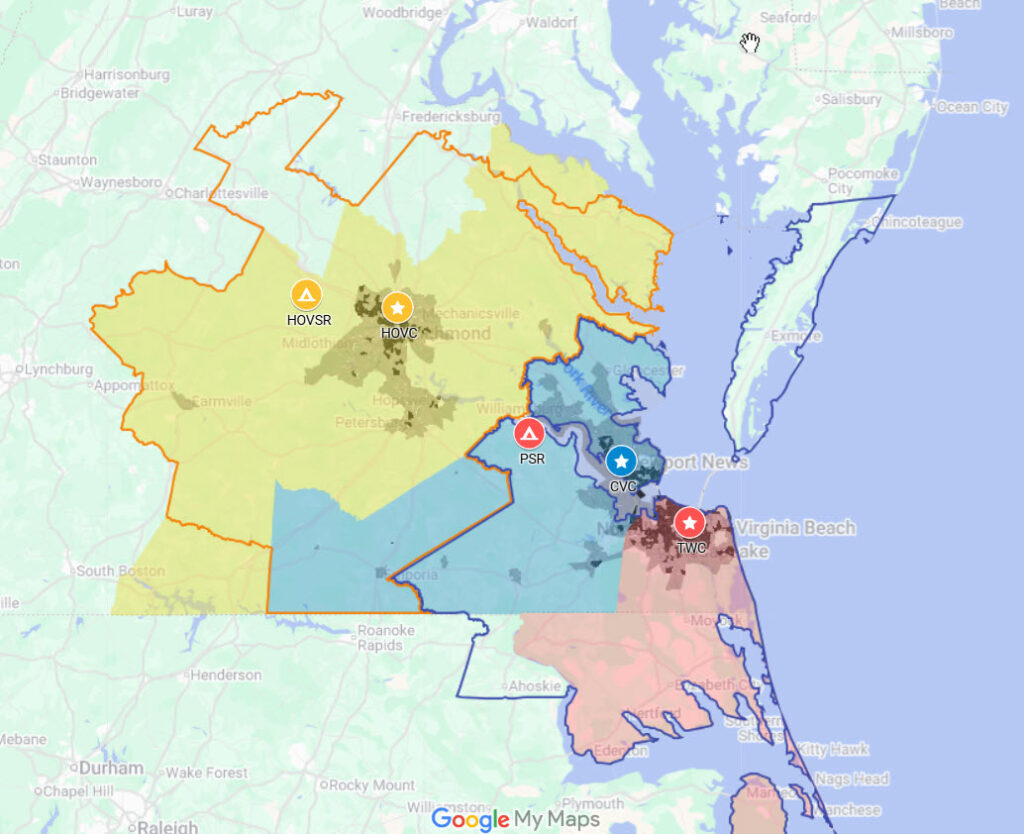
Nielsen Designated Market Areas (DMAs)
🟧 Orange Outline — Richmond-Petersburg, VA DMA
🟦 Blue Outline — Norfolk-Portsmouth-Newport News, VA DMA
- CVC communities fall overwhelmingly within Hampton Roads–based media markets
- Tidewater Council aligns with those same markets
- Heart of Virginia Council aligns with Richmond-centered media markets
Local media markets exist to serve shared daily life — local news, TV, radio, newspapers, weather, schools, infrastructure, and community identity. These are more than just outlets for information and entertainment. They are shared cultural touchpoints. Most CVC units and families receive Hampton Roads media, not Richmond media. Take a look at the comparable common Richmond & Hampton Roads media outlets. Which ones are you most familiar with?
Map 4: Telephone Area Codes and Council Territories
(See map below — dominant regional phone area codes)
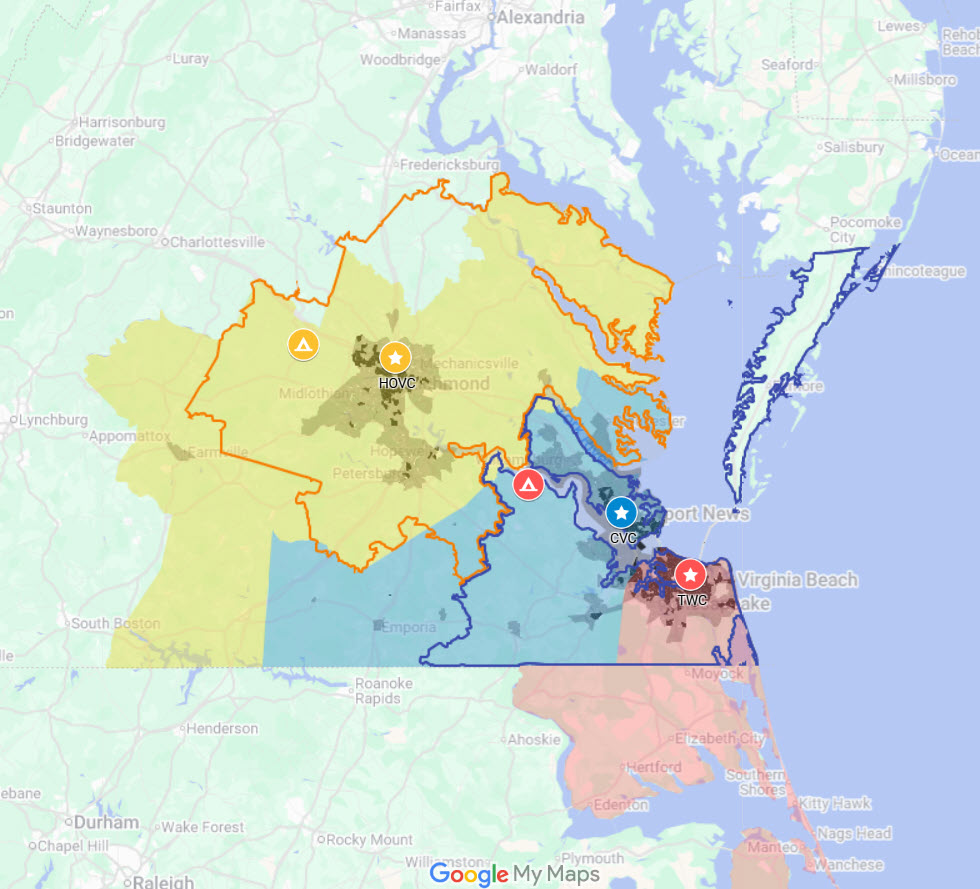
Phone Area Codes (North American Numbering Plan – NANP)
🟧 Orange Outline — 804 & 686
🟦 Blue Outline — 757 & 948
- CVC communities share Hampton Roads–oriented area codes
- Tidewater Council aligns with those same communication regions
- Heart of Virginia Council aligns with distinct Richmond-area codes
Area codes change slowly and reflect long-standing patterns of regional integration. They reinforce who communicates with whom — daily, routinely, and naturally.
The Pattern Is No Longer Ambiguous
Across population density, MSAs, typical travel, media markets, and communication regions, the outcome is the same:
- CVC communities function as part of the Hampton Roads regional system
- Tidewater Council is embedded in that same system
- Heart of Virginia Council is embedded in a different regional core
These are not Scouting-specific boundaries.
They are the same boundaries used by economists, planners, media organizations, and infrastructure providers.
When every independent regional lens points in the same direction, it is no longer reasonable to treat alignment as subjective.
Independent regional research confirms this same alignment — and explains why it matters long-term.
Independent Regional Research Confirms the Same Alignment
This conclusion is not unique to Scouting.
Independent regional research conducted by Old Dominion University’s Dragas Center for Economic Analysis & Policy³ and workforce and commuting data published through VirginiaWorks⁴ reach the same conclusion: Hampton Roads functions as a single, integrated economic and population system, separate and distinct from Richmond.
ODU’s research³ shows that commuting patterns, labor markets, institutions, and infrastructure investment reinforce this separation. VirginiaWorks labor-shed data⁴ confirms that CVC communities overwhelmingly participate in the Hampton Roads employment and commuting ecosystem — not the Richmond one.
Organizations that operate outside their natural regional alignment experience reduced participation, weaker leadership pipelines, and declining engagement over time³ ⁴. That is documented regional behavior — not speculation.
Appendage or Core Is a Structural Outcome
Every merged organization develops a center of gravity:
- where leadership is based
- where council-level events are held
- where participation is easiest and assumed
It also develops peripheral regions — not by intent, but by distance. Over time, distance reduces participation, representation, and influence.
A Hampton Roads-aligned model keeps CVC communities in the core.
A Richmond-centered model places them outside it, expected to travel in from the outskirts.
That is what “appendage” means in practice.
University of Scouting Shows the Structure Being Proposed
University of Scouting is a council-level training event. Across the country, these events are held where councils are centered in population density.
The 2026 University of Scouting locations⁸ make the pattern unmistakable:
- CVC — Yorktown, within the Hampton Roads population core
- TWC — Norfolk, also within the Hampton Roads population core
- HOVC — Richmond, in a distinct and geographically separate population core
That is not coincidence. It is councils operating where their people are.
Ask yourself honestly:
Would this still feel sustainable if council-level events were routinely centered in Richmond — or farther away at HOVC’s camp? Or would CVC communities become peripheral?
The Unit-Level Travel Data Removes Doubt
Our unit-by-unit travel analysis for 94 CVC units⁶ shows:
- 81 units are closer to both Tidewater’s HQ and Pipsico Scout Reservation
- 8 units are closer to Pipsico but closer to the Heart of Virginia HQ
- 4 units are closer to Tidewater’s HQ but closer to the Heart of Virginia camp (HOVSR) by an average of only 6 minutes
- 1 unit in Gloucester is technically closer to both Heart of Virginia destinations — but only by 5 minutes for camp and 1 minute for the HQ, not enough to materially change the overall regional trend
Zero CVC units are meaningfully closer to Richmond locations⁶.
Population density¹, MSAs², and real-world travel all point in the same direction: Hampton Roads.
Appendage or Core Extends to the Boardroom
This dynamic does not stop at geography. It extends directly into governance and representation.
Under the proposed HOVC–CVC structure⁵, board composition creates an approximate 40–20 advantage for HOVC-aligned representation — leaving CVC communities outnumbered 2-to-1 on the governing body responsible for budgets, staffing, properties, and program priorities.
By contrast, discussions with Tidewater Council included parity-based (50/50) governance concepts⁵. Final board numbers with TWC were never settled — not due to disagreement, but because the process never progressed far enough. As documented in our Full Merger Review⁵:
- TWC and CVC met once
- That meeting was one-way information sharing from TWC to CVC
- CVC did not respond to invites by TWC for collaborative working sessions or follow-ups
The Tidewater option was not rejected after analysis. It was set aside before analysis could occur.
A council that enters a merger already outnumbered has not joined a partnership. It has accepted appendage status.
The “Review” Is Not Sufficient for a Decision of This Magnitude
Board members will likely point to the December 12 merger update⁷ as “enough research” or “sufficient due diligence.”
As documented in detail in our Full Merger Review⁵, it is not. That update:
- omits key comparative context
- selectively frames time windows
- downplays and omits significant operating budget deficits
- minimizes the impact of mandatory fee increases implemented by HOVC to offset those deficits
Across governance, finance, program access, travel, membership trends, and regional alignment, the conclusion is consistent:
Tidewater Council is the more geographically aligned, operationally and financially coherent, and community-centered partner for CVC⁵.
Reassurance is not diligence. A decision of this magnitude requires time for a complete and balanced analysis.
Looking Ahead to Town Halls
In the coming weeks, members will have the opportunity to ask questions directly at town halls about how this merger decision was evaluated and what it means for CVC communities.
Our next article, to be posted shortly before those town halls, will focus specifically on:
- the decision criteria used by the board
- what documentation exists (and what does not)
- how members can assess whether each merger option was evaluated fully and comparably
For now, we encourage members to review the data presented here & our Full Merger Review⁵, reflect on what core versus appendage would mean for their units and families, and be prepared to engage thoughtfully and constructively when those discussions begin.
What Happens Next
Only Council Voting Members — including Chartered Organization Representatives (CORs) for now — can vote YES or NO on a merger.
Between now and the expected late February / March final vote:
- Be vocal at town halls
- Talk to your COR now and ensure that they will attend town halls & the final vote
- Demand more time for an equal & comprehensive evaluation of Tidewater Council
- Be prepared to vote NO on an HOVC–CVC merger
A NO vote does not reject merging. It rejects a misaligned outcome and an incomplete process.
Final Consideration
Once a council becomes an appendage, it does not move back to the center.
The evidence is already on the table.
Appendage — or Core.
What is your choice?
Respectfully,
Hampton Roads Scouting Alliance
A volunteer-led group focused on transparency, member voice, and the long-term strength of Scouting in Hampton Roads
hrscouting.org
References
¹ U.S. Census Bureau — American Community Survey (ACS) 2019–2023
² U.S. Census / OMB — Metropolitan Statistical Area Definitions & Maps
³ Old Dominion University Dragas Center — State of the Region & State of the Commonwealth
⁴ VirginiaWorks — Labor-Shed & Workforce Commuting Data: Hampton Roads, Richmond, Virginia
⁵ Hampton Roads Scouting Alliance — Full Merger Review
⁶ Hampton Roads Scouting Alliance — CVC Unit-Level Travel Analysis
⁷ CVC Executive Board Merger Update (December 12)
⁸ Map: Council Territories, Key Locations, MSA Borders, Population Density, DMAs, Are Codes
⁹ Nielsen Designated Market Areas (DMAs) — Southeast Virginia & Richmond Media Markets
¹⁰ North American Numbering Plan (NANP) — Telephone Area Codes: 804 / 686 & 757 / 948